

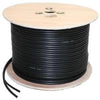


Combi cables
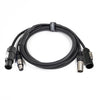
Combi cables are special cables where power and signal are combined in one and the same cable. Instead of running a separate power cable and a separate signal cable between, for example, a mixer and active speakers or between a light controller and lamps, a combi cable provides a combined solution developed for professional audio, lighting, and AV use. This results in less cable clutter, faster setup, and a more manageable setup – especially on stages, in touring rigs, and fixed installations.
At SoundStoreXL, you will find a wide selection of combi cables from Perfex for both sound and light. The range spans from IEC and XLR combi cables for audio, Powercon and XLR DMX multicables for lighting, as well as Powercon and CAT7 combi cables for modern digital stage boxes and network-based solutions. All cables in the collection are designed for demanding use in professional environments where reliability and quick handling are crucial.
How to choose the right combi cable for your setup
The choice of combi cable primarily depends on whether you are working with sound, light, or digital network solutions – and which connector types your equipment uses. To choose correctly, you should start by looking at your actual signal flow and the connectors you have on both the supply side and the device side.
- For active speakers and audio equipment, IEC and XLR combi cables are ideal when you want to carry power and balanced audio in one cable.
- For stage lighting with DMX control, Perfex Powercon and XLR multicables as well as Perfex True1 and XLR combi cables are ideal when you want to combine power and DMX signal.
- For digital stage boxes, remote boxes, and speakers with Ultranet, Perfex Powercon and CAT7 combi cables are developed to combine power and network.
Additionally, you should consider the need for length, cable thickness, and flexibility. On smaller stages or in the studio, short cables of 1–3 meters may be sufficient, while touring productions and larger stages often require lengths up to 10 or 20 meters. A well-chosen combi cable provides both order and security without compromising on sound or light quality.
Types of combi cables at SoundStoreXL
The collection of combi cables at SoundStoreXL is built around a few, thoroughly tested types that cover the most common needs in live sound, stage lighting, and AV installations. Common to them is that they come from Perfex and are developed for professional use.
- IEC and XLR combi cables for audio – combines mains power (Schuko to IEC) and balanced XLR audio signal in one cable.
- Perfex Schuko and XLR combi cables for audio – equivalent solution focusing on active speakers and audio lines over shorter distances.
- Perfex IEC and XLR DMX multicables – cables where IEC power and XLR DMX signal run parallel, typically for lighting equipment.
- Perfex Powercon and XLR DMX multicables – combine Powercon power and 3-pin XLR DMX for professional stage lighting.
- Perfex True1 and XLR combi cables – for lamps and equipment with True1 power plugs, combined with XLR DMX signal.
- Perfex Powercon and CAT7 combi cables – combine Powercon power with a full SFTP CAT7 cable for network and digital audio systems.
By choosing the right type of Combi Cable, you avoid temporary solutions and homemade cable bundles. Instead, you get a professional, factory-made solution that is easy to handle, service, and replace as needed.
Combi Cables for audio – IEC and XLR in one cable
For active speakers, smaller PA systems, and mobile sound setups, IEC and XLR Combi Cables are a simple and effective solution. In this category, you will find, among other things, Perfex XLR and IEC power cables for audio in lengths such as 3, 5, and 10 meters, as well as IEC and XLR Combi Cables for audio in corresponding variants.
- Supply end: Schuko and XLR female – typically at mixer, stage box, or power distributor.
- Device end: IEC and XLR male – direct connection to your active speaker or amplifier.
- Quality cables with a robust jacket, suitable for repeated setup and teardown.
With these Combi Cables, you only run one cable per speaker instead of handling both a power cable and an XLR cable. This significantly reduces clutter on stage and speeds up load-in and load-out, especially if you work a lot alone or with small teams.
Combi Cables for stage lighting – Powercon, True1, and DMX
Stage lighting and light effects require both stable power and a reliable DMX signal. Perfex has therefore developed a complete series of Combi Cables for lighting, where power and DMX are combined. In SoundStoreXL’s range, you will find several lengths and variants, so you can match both small and large rigs.
- Perfex IEC and XLR DMX multicables in 3 and 10 meters – for lighting equipment powered via IEC plugs and controlled with XLR DMX.
- Perfex Powercon and XLR multicables in 1, 1.5, 3, 5, 10, and 20 meters – for fixtures and systems with Powercon power connection.
- Perfex True1 and XLR combi cables in 1, 1.5, 3, 5, and 10 meters – aimed at lamps with True1 power, where you also run DMX in the same cable.
All these Combi Cables are constructed with a power section, typically around 3 x 2.5 mm² or 3 x 1.5 mm² depending on the model, and a signal section with DMX-friendly conductors, e.g., 2 x 0.22 mm². The construction ensures that you get both correct power capacity and stable DMX transmission over the specified lengths.
Combi Cables for digital systems – Powercon and CAT7
Modern audio and AV setups are increasingly based on digital stage boxes, network protocols, and remote control. Here, Combi Cables with Powercon and CAT7 are a practical solution when you want to run both power and data in a single cable run.
- Perfex Powercon and CAT7 Combi Cables are available in 1, 1.5, 3, 5, 10, and 20 meters.
- Power: 3 x 1.5 mm² via Powercon – suitable for many digital boxes and network components.
- Network: CAT7 SFTP – shielded cable suitable for professional audio and AV networks.
These Combi Cables are ideal for use between digital stage boxes, CAT remote boxes, or as a link between speakers with, for example, Ultranet connection. This way, you can keep the stage edge clear of loose cables while ensuring efficient, manageable cable management that is easy to troubleshoot and replace when needed.
Applications: where do Combi Cables make the most sense?
Combi Cables are typically used where you have repeated setups, limited time or space, and where order in cable management is important for both safety and appearance. In practice, this means they are especially popular in the following environments:
- Live stages and touring – quick setup of active speakers, front lights, and backdrop lighting.
- Event and rental companies – standardized cable packages that are easy for different technicians to handle.
- Conference and meeting rooms – neat cable management for fixed speakers and lighting zones.
- Churches, schools, and cultural centers – AV installations where both power and signal need to reach the same point.
- Mobile DJs and bands – compact setups where everything needs to get in and out of the car quickly and without cable chaos.
If you often find yourself with large bundles of single cables, or you spend time pairing the right cables before you can power up the system, Combi Cables are an obvious upgrade that can make your daily routine noticeably easier.
Advantages and disadvantages of Combi Cables
Combi Cables offer many practical advantages, but it's also important to be aware of the natural limitations. Here is a brief overview to help you assess whether Combi Cables are the right solution for your setup.
- Advantages:
- Less cable clutter on stage or in the installation.
- Faster setup and teardown, especially for repeated productions.
- Less risk of forgetting either the power or signal cable.
- Consistent and professional appearance in cable management.
- Disadvantages:
- Less flexibility if you often change lengths and placements.
- Slightly higher purchase price than separate standard cables.
- If there is a fault in one part, the entire cable often needs to be replaced.
For many users, the advantage of a tidy, quick, and stable setup clearly outweighs the disadvantages. Especially if you work professionally and have fixed workflows, Combi Cables can save both time and frustrations from the first use.
Installation and practical handling of Combi Cables
Although Combi Cables are robust, they benefit from proper handling. This applies both to temporary stages and fixed installations. Good practice starts when you plan your cable routing and choose the right lengths.
- Plan the cable routing so that the cables follow natural lines along walls, stands, and trusses.
- Avoid unnecessarily tight bends and sharp angles, which can stress both the power and signal sections.
- Use cable ties or Velcro to bundle Combi Cables with other necessary cables.
- Roll up the cables correctly using the over/under technique to avoid twists and internal stress.
For fixed installations where you run Combi Cables in pipes or cable trays, it is important to adhere to the general guidelines for tensile strength and bending. Feel free to use a pull spring in empty pipes and ensure there are no sharp edges in the cable trays. All work with fixed 230V installations must, of course, be carried out by an authorized installer.
Safety, durability, and choice of materials
Safety and operational stability are key parameters when choosing Combi Cables. The cable's outer jacket, conductor thickness, and construction greatly influence how it withstands daily use, temperature variations, and mechanical wear. Perfex Combi Cables are designed for professional use, where special demands are placed on both robustness and flexibility.
- The power conductors are dimensioned for typical loads of audio and lighting equipment.
- The signal sections (XLR, DMX, CAT7) are constructed with shielding and conductor types that support stable signal transmission.
- The outer jacket is designed to withstand repeated coiling, uncoiling, and transport.
If you work in environments where fire ratings or specific installation standards are required, you should always check the technical specifications for each cable and possibly supplement with dedicated installation cables for the fixed part of the system.
Maintenance and lifespan of Combi Cables
Proper maintenance significantly extends the lifespan of your Combi Cables and reduces the risk of operational downtime during a production. Simple routines after each use can be the difference between a cable that lasts months and one that lasts years.
- Avoid pulling on the cable itself when disconnecting connectors; always grip the connector.
- Regularly check for visible damage, flat pressure marks, or bends.
- Clean connectors with appropriate cleaning agents if exposed to dust, smoke, or moisture.
- Store cables dry and at a moderate temperature, preferably in cable cases or on cable reels.
Should you experience failures in either the power or signal part, it is often safest and operationally sensible to replace the entire Combi Cable rather than make temporary repairs. This provides more predictable operation, especially in critical productions.
Combi Cables vs. separate cables – what should you choose?
The choice between Combi Cables and separate cables is primarily about workflow, flexibility, and economy. Separate cables provide maximum freedom to combine lengths and types, but at the expense of clarity. Combi Cables, on the other hand, combine two or more functions in one product.
- Combi Cables are strongest when you have fixed, repeated setups with the same distances.
- Separate cables can be advantageous in setups that frequently change structure or lengths.
- In case of a fault in a Combi Cable, you replace one cable; with separate cables, you can replace only the defective type.
- In return, Combi Cables often reduce errors caused by incorrect or forgotten cables.
A combined strategy is the best solution for many: Use Combi Cables for central, fixed connections – e.g., between mixer and front PA or between lighting bridge and dimmer – and supplement with individual separate cables where you need extra flexibility.
Modern trends: network-based AV and Combi Cables
The development within the audio and AV world is moving towards network-based systems, where audio, control, and video are distributed via standardized network cables. Here, Combi Cables with Powercon and CAT7 fit naturally, as they combine reliable power supply with high-performance data transport.
- Digital stage boxes can be powered and connected with a single physical cable run.
- Remote boxes for remote control can be neatly mounted without visible cable bundles.
- New speaker systems with digital links utilize Combi Cables for both power and signal.
Even as technologies and protocols evolve, the need for secure, mechanically robust cables remains constant. With the Combi Cables you find in this collection, you are well-equipped for both classic analog audio, DMX-controlled stage lighting, and modern, network-based solutions.
FAQ – frequently asked questions about Combi Cables
Below you will find answers to typical questions that arise when first considering switching to Combi Cables in your audio or lighting setup.
- What is the difference between a Combi Cable and regular cables?
- A Combi Cable combines several functions in one physical cable – typically power and signal, such as XLR, DMX, or CAT7. With regular cables, you need to run a separate power cable and a separate signal cable, which results in more loose cables and more cable clutter.
- Can you join two cables instead of using a Combi Cable?
- Technically, you can of course run a power cable and a signal cable next to each other, but you do not achieve the same advantages in terms of clarity and handling. Temporary solutions with tape or homemade bundles are also more prone to damage. A dedicated Combi Cable is usually both more reliable and easier to work with.
- How do you pull a Combi Cable in conduits or cable trays?
- Use a pull spring and ensure that pipes or trays have sufficient space for the cable's diameter. Avoid sharp bends and be aware of maximum tensile strength. The actual connection of 230V in fixed installations must always be performed by an authorized installer.
- How long can Combi Cables be?
The length depends on both power needs and signal type. In SoundStoreXL's range, you will find Combi Cables up to 20 meters, such as Perfex Powercon and XLR multicables and Perfex Powercon and CAT7 Combi Cables. In practice, these lengths are suitable for everything from small stages to larger event setups, as long as you stay within the equipment's recommendations.
Buy your Combi Cables at SoundStoreXL
When you choose Combi Cables from Perfex at SoundStoreXL, you get cables specifically developed for professional use in audio, lighting, and AV. The range covers everything from IEC and XLR Combi Cables for active speakers to Powercon and True1 solutions for stage lighting to Powercon and CAT7 cables for modern digital systems. This allows you to build a cohesive and well-thought-out setup across your entire system.
Whether you are a DJ, sound engineer, lighting technician, installation company, or responsible for AV in a business or institution, you can find Combi Cables in lengths and types that match your needs. If you need help choosing between, for example, IEC and XLR Combi Cables for audio or Powercon and XLR DMX multicables for lighting, SoundStoreXL's customer service is ready to advise you on the most practical and future-proof solution for your setup. Buy your Combi Cables at SoundStoreXL – 100% Danish retailer.
