


DMX Splitters
(7 products) In stock (only 1 pcs.) · Delivery time: 3–5 business days
External warehouse – Estimated delivery in 10–12 business days. 
External warehouse – Estimated delivery in 7–12 business days. 
External warehouse – Estimated delivery in 7–12 business days. 
External warehouse – Estimated delivery in 9–12 business days. 
External warehouse – Estimated delivery in 6–12 business days. 
External warehouse – Estimated delivery in 9–12 business days.


Read more DMX Splitters
Read more DMX Splitters
DMX Splitter
What is a DMX Splitter – and why is it necessary?
A DMX splitter is a central component in professional lighting setups, where multiple units need to be controlled stably via DMX signals (Digital Multiplex). The purpose is to take one incoming DMX signal and distribute it to several separate outputs without the signal losing quality or being affected by noise.
In practice, a DMX splitter is used to divide the signal into multiple independent lines. Each output functions as its own DMX chain, meaning that faults in one part of the system do not affect the rest. This is a significant difference from the classic “daisy chain,” where the signal is sent from one unit to the next in line.
How signal distribution works in a DMX setup
In a DMX system, a digital control signal is sent from a controller to various lighting units via DMX Cables. Without a splitter, the units are connected in series, which can create problems with long cable runs or many connected units.
A DMX splitter solves this by buffering and regenerating the signal before it is sent to each output. Most professional DMX512 splitters have galvanic isolation, meaning that electrical faults or noise do not spread between the individual lines.
Typically, the splitter is placed close to DMX controllers or centrally in the installation, from where separate cables are run to, for example, moving heads, LED PAR Cans and other lighting effects.
Different types of DMX splitters
DMX splitters come in several variants depending on the need. Smaller models typically have 2–4 outputs and are used in simple setups, while larger solutions can have 8 or more outputs for complex installations.
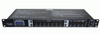
Rack-mounted splitters are often used in fixed installations or touring setups, where they are integrated with other equipment such as DMX interfaces, controllers, and power distribution. Compact models are popular among mobile DJs and event technicians who need flexible and quick setup.
Many splitters also function as signal boosters, allowing for longer cable runs without signal loss. In larger systems, they are often combined with wireless DMX solutions and advanced lighting control.
How to choose the right DMX splitter
The choice primarily depends on the size of your setup and how many separate lines you need. It is often advantageous to choose a model with more outputs than the current need, allowing room for expansion.
Galvanic isolation on each output is an important factor in professional setups, as it reduces the risk of noise and faults. In cheaper solutions, this feature is often missing, which can lead to unstable operation.
It is also important to choose the correct connector type. Professional systems typically use 5-pin DMX (XLR), while many smaller units use 3-pin. Although adapters can be used, a consistent standard provides the most stable solution.
A classic mistake is to overlook the correct termination of DMX lines. Even with a splitter, each line must be properly terminated to avoid reflections in the signal.
Practical applications and expert insights
In practice, DMX splitters are used to divide lighting setups into zones – for example, stage lighting, effect lighting, and audience lighting. This makes troubleshooting easier and provides more stable operation.
A typical challenge without a splitter is that one defective unit or a bad cable can affect the entire chain. With a splitter, the problem is isolated to one output, which is crucial in live situations.
For mobile DJs, a DMX splitter provides a more robust setup, especially when multiple lighting effects are connected. In larger productions, it is a fixed part of the signal infrastructure along with cables, controllers, and lighting equipment.
In fixed installations such as clubs, theaters, and conference venues, the splitter is often mounted in a rack and functions as a permanent part of the system, where operational reliability is crucial.
Whether you work with small or large lighting setups, a DMX splitter is an essential component for stable and professional signal distribution. See the full range at SoundStoreXL.com
Frequently Asked Questions
What is the difference between a DMX splitter and a booster?
A splitter distributes the signal to multiple outputs, while a booster primarily amplifies the signal. Many devices combine both functions.
Is a DMX splitter necessary?
In small setups, you can manage without, but with multiple units or long cables, a splitter is recommended.
What does galvanic isolation mean?
It means that each output is electrically isolated, which protects against noise and faults.
Can you use both 3-pin and 5-pin DMX?
Yes, with adapters, but it is best to maintain the same standard throughout the setup.
Where is a DMX splitter placed?
Typically close to the DMX controller or centrally in the lighting setup.
Also see if you might not need a DMX controller which you can buy cheaply nowadays

Get exclusive deals and member discounts
Join Club SoundStoreXL for free and get more out of every order.
- 100-day right of return for members (normally 30 days)
- Members-only discounts
- Priority order handling
- Early VIP access to select campaigns
- Important product news and deals
- Exclusive events