




Marimbas
(1 products) Save 22%In stock · Delivery time: 3–5 business days

Read more Marimbas
Read more Marimbas
Marimba - an atypical instrument
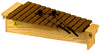
A marimba is a musical instrument in the percussion family. The sound is produced by striking wooden keys with mallets. The keys are arranged like on a piano, where the notes that are black keys on the piano are positioned elevated and overlapping the "white" ones. This helps the musician both visually and physically. The marimba is tuned one octave lower than its family member, the xylophone. Both the marimba's and xylophone's keys are usually made of rosewood, but synthetic alternatives are becoming increasingly popular. The marimba's keys are both wider and thinner, especially in the middle, than the xylophone's. This allows other levels of the overtone series to resonate more and the tone becomes richer.
Today, the marimba is particularly used in harmony orchestras and symphony orchestras.
Read more about the marimba on Wikipedia: click here
Where does the marimba originate from?
According to oral traditions, the story of the marimba began long ago in Africa. Holes were dug in the ground, and wooden bars were cut and laid next to each other over this hole. Then the bars were struck to produce sound. This means a kind of xylophone emerged that worked by the sound produced by the strikes on the wooden bars resonating in the hole. Sometimes, gourds were attached to the underside of the wooden bars. The gourds acted as resonating chambers for the sound. Instruments like this are still known as traditional folk instruments in several parts of Africa. Interestingly, it is said that South Africa's Zulu tribe has folk myths about a goddess named Marimba who created a xylophone with attached gourds.
The instrument crossed the Atlantic with the African people and arrived in Central and South America. Here, the gourds were replaced with resonating tubes made of wood. Eventually in America, the wooden tubes that were fixed were made of metal, resulting in the modern marimba.
Why and for what purpose the "original" marimba came into existence cannot be said with certainty.
Choosing the right marimba
Overall, there are two things to consider, regardless of who is going to buy a marimba. These are material and the number of octaves. Rosewood has long been used as a material for sound plates, and it actually has excellent properties. It is also the material that marimba enthusiasts love. Another popular material, alongside rosewood, is padauk. The material itself is soft and produces a softer tone than rosewood. There are also FRP sound plates designed to produce a sound similar to that of rosewood but made with a different material. FRP stands for fiber-reinforced plastic (Fiber-reinforced-plastic). It is a synthetic material made by compressing a bundle of glass fibers together with plastic. Compared to wood, this material is relatively unaffected by changes in the environment, allowing for instruments to be played with a consistent sound all the time.
The most common pitch range for a marimba is fire octaves. When the instrument is used to play in a band, almost all songs are covered by this interval. Instruments that have been extended to fire and a half octaves by adding seven tones to the low end of a fire octave model meet the need for expansion to the marimba repertoire. In particular, these instruments are prominent in the role of the bass part in a percussion ensemble. The five-octave marimba is an instrument that can cover almost all contemporary music and music written for marimba players. In music schools and in the professional world, this range has now become standard.
